I have been out and about the last few weeks ringing my cowbell for cyclists trying to go as fast as possible up very steep hills. The most important hill climb of the year is the National, which took place up a very steep hill in Stocksbridge.
![thumbnail_20181027_154135[1]](https://horacethealresfordbear.com/wp-content/uploads/2018/10/thumbnail_20181027_1541351.jpg?w=584)
We arrived the day before as Stocksbridge is 190 miles away from Bristol. On checking out the hill we found many cyclists doing the same. I concluded that the hill is too steep for bears.
![thumbnail_20181027_172052[1]](https://horacethealresfordbear.com/wp-content/uploads/2018/10/thumbnail_20181027_1720521.jpg?w=584)
The resting place for the night was the Dog & Partridge Inn, though oddly no dogs were allowed inside. There were no specific rules regarding partridges or bears, so I went inside.
![thumbnail_20181027_165901[1]](https://horacethealresfordbear.com/wp-content/uploads/2018/10/thumbnail_20181027_1659011.jpg?w=584)
After a long journey I was quiet tired so after finding my room I climbed up onto the bed for a nap.
![thumbnail_20181027_170619[1]](https://horacethealresfordbear.com/wp-content/uploads/2018/10/thumbnail_20181027_1706191.jpg?w=584)
Twenty minutes later I was woken by someone else being shown into my room. Unfortunately it turned out not to be my room; I was in the wrong one, which was rather embarrassing. After a toddle down the corridor I found the right room where I later settled down for the night.
![thumbnail_20181027_214943[1]](https://horacethealresfordbear.com/wp-content/uploads/2018/10/thumbnail_20181027_2149431.jpg?w=584)
Prior to a day of mascot duties it is important to have a good breakfast.
![thumbnail_20181028_094933[1]](https://horacethealresfordbear.com/wp-content/uploads/2018/10/thumbnail_20181028_0949331.jpg?w=584)
I had to be carried up the hill by my human as there was no way that my little legs could manage the climb. Here I am watching some of the young riders. Another spectator spoke to my human and said she had thought at first that I was a human baby being shaken about. I guess sometimes babies wear furry babygrows.
![thumbnail_20181028_113828[1]](https://horacethealresfordbear.com/wp-content/uploads/2018/10/thumbnail_20181028_1138281.jpg?w=584)
As cyclists reached the finish line at the top of the hill they all looked very tired indeed. Fortunately there were people in yellow jackets catching them and helping them safely get off their bikes.
![thumbnail_20181028_122527[1]](https://horacethealresfordbear.com/wp-content/uploads/2018/10/thumbnail_20181028_1225271.jpg?w=584)
The other spectators were all very friendly.
![thumbnail_20181028_122657[1]](https://horacethealresfordbear.com/wp-content/uploads/2018/10/thumbnail_20181028_1226571.jpg?w=584)
I cheer and ring my bell for everyone as they are all amazing being able to cycle up steep hills. My human’s son gets an extra big cheer – here he is whizzing off into the distance.
![thumbnail_20181028_133908[1]](https://horacethealresfordbear.com/wp-content/uploads/2018/10/thumbnail_20181028_1339081.jpg?w=584)
Here’s a video clip – I am briefly in it at the start and end.
The weather was very cold and for about 10 minutes or so sleet started to fall. I had to climb into a plastic carrier bag to protect my fur. The cyclists had to battle the sleet as well as the steep gradient. (Not a good quality photo – my human’s hand were freezing cold)
![thumbnail_20181028_140831[1]](https://horacethealresfordbear.com/wp-content/uploads/2018/10/thumbnail_20181028_1408311.jpg?w=584)
Due to humans with freezing hands we made our way down the hill, still ringing cowbells to support competitors on the way up. At the bottom we found a little tearoom, Samuel’s Kitchen, which was warm and dry.
![thumbnail_20181028_144017[1]](https://horacethealresfordbear.com/wp-content/uploads/2018/10/thumbnail_20181028_1440171.jpg?w=584)
The race headquarters was situated in the Trek shop; a huge shop full of shiny new bicycles. I tried out a few and thought this one would be good for bears if it came in a slightly smaller size.
![thumbnail_20181027_160028[1]](https://horacethealresfordbear.com/wp-content/uploads/2018/10/thumbnail_20181027_1600281.jpg?w=584)
I could see myself in the big silver trophy!
![thumbnail_20181028_151432[1]](https://horacethealresfordbear.com/wp-content/uploads/2018/10/thumbnail_20181028_1514321.jpg?w=584)
All the riders names were displayed on big white boards and people were sticking their times next to them. They all looked to have done very well.
![thumbnail_20181028_151502[1]](https://horacethealresfordbear.com/wp-content/uploads/2018/10/thumbnail_20181028_1515021.jpg?w=584)
Here are the three women that went up the hill fastest. The one in the middle got first prize and received a special jersey.
![thumbnail_20181028_164229[1]](https://horacethealresfordbear.com/wp-content/uploads/2018/10/thumbnail_20181028_1642291.jpg?w=584)
After watching the presentations it was time for a curry with a group of cyclists from the Bristol Area. I discovered that bears like curry.
![thumbnail_20181028_191104[1]](https://horacethealresfordbear.com/wp-content/uploads/2018/10/thumbnail_20181028_1911041.jpg?w=584)
A great weekend though somewhat tiring for a small bear. I was glad to get home and tucked into my own bed.
![thumbnail_20181029_000753[1]](https://horacethealresfordbear.com/wp-content/uploads/2018/10/thumbnail_20181029_0007531.jpg?w=584)
Back to being just a normal Alresford Bear now for the winter.
Horace the Alresford Bear 29/10/18
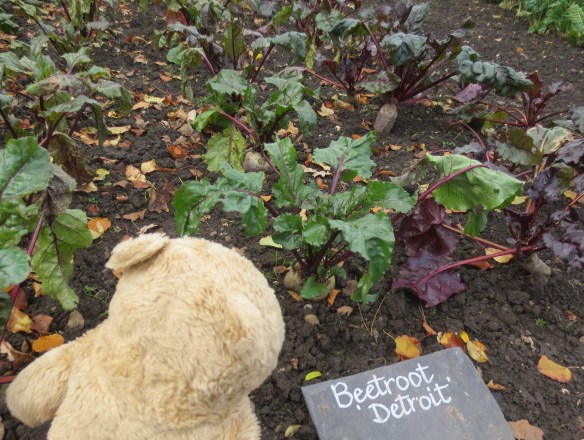
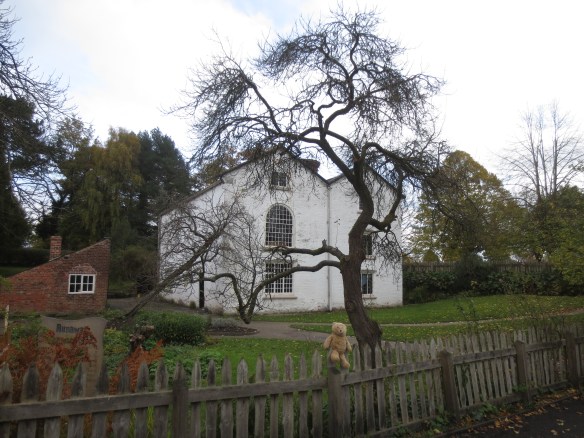 There is an allotment garden outside the house that used to be tended by the children after they completed their long shifts in the mill. Nowadays it is tended by National Trust volunteers; the beetroot looked very tasty.
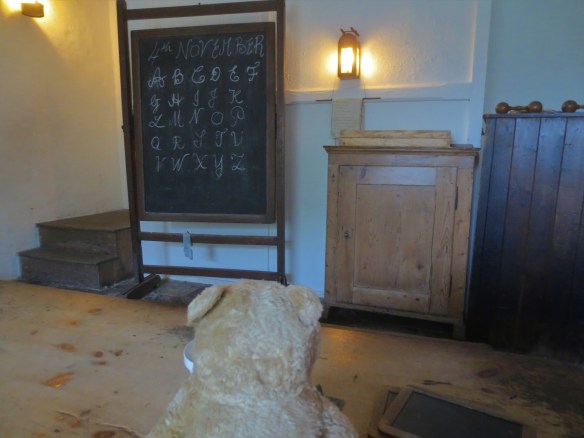
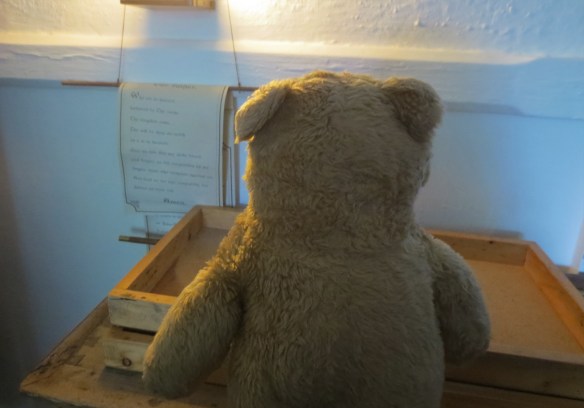
 We joined a group of humans having a tour of the house. First stop was the school room. The children used to have lessons here on Sunday afternoons after going to church. Monday to Saturdays were spent working in the mill from 6am in the morning until 7pm in the evening. They must have been very tired.
 I tried my paw at writing on a slate with slate. It was a tad difficult.
 They started off learning to write letters by drawing them in a tray of sand. I didn’t try this as didn’t want to get sand stuck in my fur.
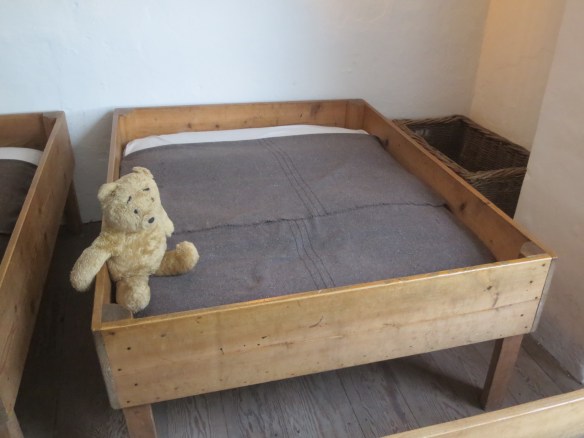
 The lady doing the tour didn’t want to be held up by people taking photographs so we quickly followed the rest of the group upstairs to the dormitory where the children slept two to a bed. The beds were very small; poor people didn’t used to grow very tall then as they didn’t get enough nutritious food and had to work very hard.
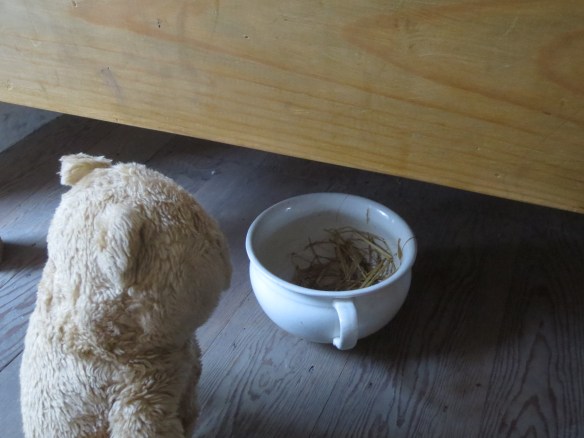
  The children used to get to their dormitory by means of a ladder through a trap door and were shut in for the night. If they needed to do a wee or a poo they had to use a chamber pot and wipe their bottoms with some straw.
 Next we went into a room that would’ve been the boy’s dormitory but a table had been put there to show some of the remedies that the doctor would have used when the mill workers were ill. The leeches were used to draw out infected blood; they are still used today for some medical uses.
  This pot contains Brimstone and treacle. It was used for all sorts of ailments and made people go the toilet. I am glad I wasn’t around back then!
 Finally we went into the kitchen where a real fire was roaring. The guide told us all about the food that the apprentices ate, and that although they had a hard life it they had better conditions than some other mills.
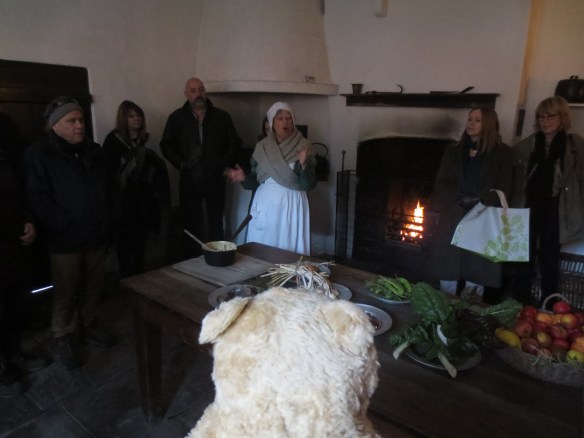 The porridge looked a bit thick. Apparently it was made deliberately like this as the children would have been taken some for breakfast while they were working. A dollop would have been given to them in their hand and straight after eating it they would have to get back to work.
 The water pump where the children would have been able to wash. It must have been very cold to use this in the winter.
 I didn’t feel inclined to try out the toilet.
 I did however try on a hat from the dressing up clothes that you often find in National Trust properties for children. I think I look good in caps.
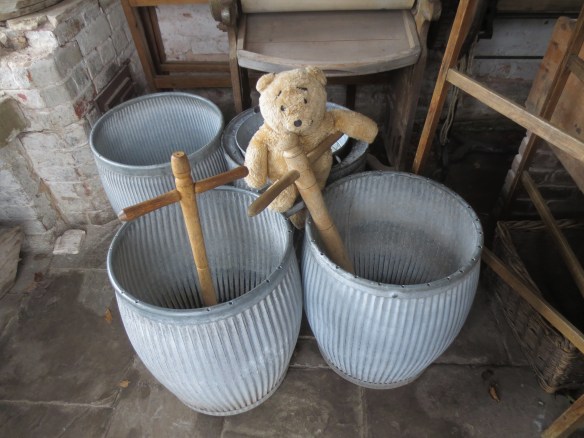
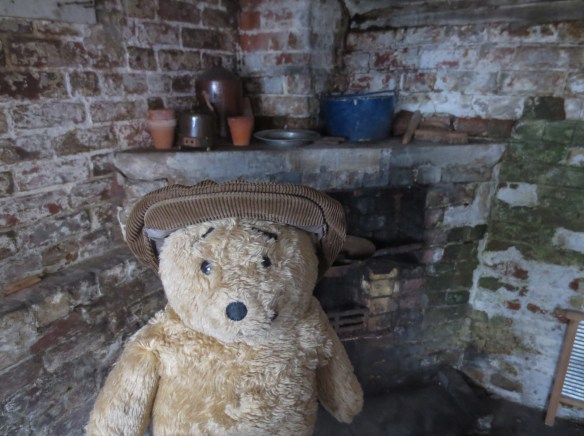 The washing of clothes was carried out using ‘washing dollies’ which must have been very hard work. People didn’t change their clothes so often 200 hundred years ago. The mill children had 2 sets of clothes each and put fresh ones on each Sunday for church and wore them for the following week.
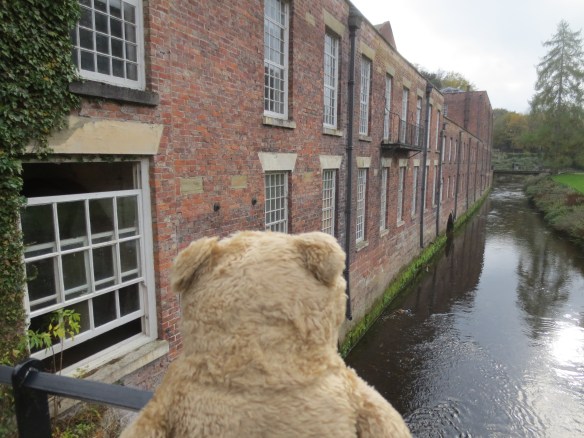
 A walk down from the Apprentices’ house took us to Quarry Bank Mill.
 Some of the trees were a splendid orange colour due to it being autumn.
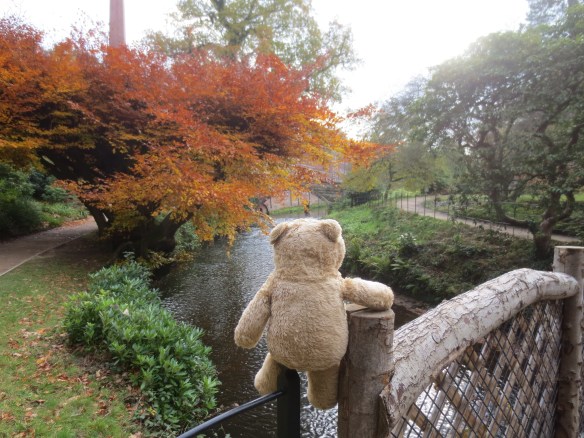 This is the stream that feeds the giant water wheel which is still working at over 200 years old.
 No visit to a National Trust property is complete without a stop for some cake. The Mill Café was so busy I had to sit upstairs in the overflow area, which is also a function room.
 With a full tummy it was time to look around the mill.
 The mill still has lots of the original machinery and is also a museum. This lady was demonstrating how cotton was turned into fabric before mass industrialisation. Here she is showing me how to ‘card’ the raw cotton and make it into fluffy cotton wool. This has to be done before raw cotton can be made into thread for weaving.
 Cotton has to be spun round and round to make a strong continuous thread. It can be done totally by hand but takes a very very long time, so the spinning wheel was invented.
 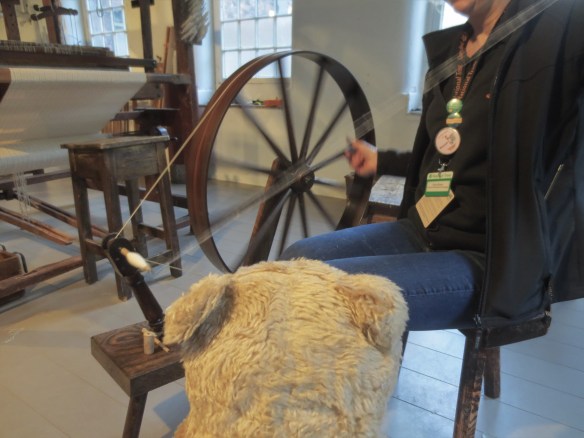 The spun cotton was then made into cloth using a pedal powered loom. The fabric could only be a wide as the operator’s arm pulling the shuttle across the fabric.
 Spinning was also made more efficient with the invention of the Spinning Jenny which was invented by James Hargreaves in 1764.
 In another big room weaving was being done by lots of big powered machines which were being driven by the power harnessed from a water wheel and also steam engines.
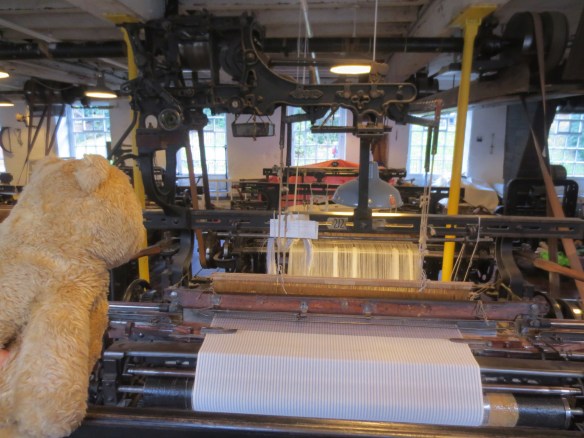 When the machines were running is was very very noisy. I was very grateful to this kind National Trust guide who me borrow some protective ear muffs.
  On another floor we found this giant carding machine that turns the cotton into cotton wool.
 The spinning was happening so quickly it looked as though all the reels were still.
 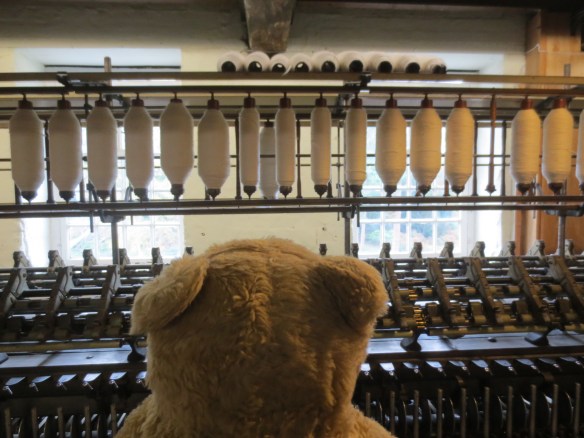 This bit of weaving equipment looked like something for bears to stay away from. The person setting up the weaving machine must certainly not be clumsy.
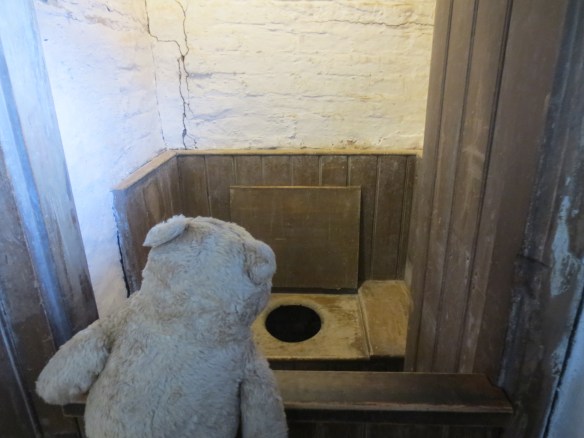
  Another toilet…
 There was an exhibition with boards with information about the lives of the workers and the working conditions. Apparently it was hot and humid as that was best for the cotton, and dusty, which wasn’t good for the workers’ lungs. I tried on a pair of Lancashire clogs that felt heavy and uncomfortable.
 The huge waterwheel was at first the main source of power in the mill.
 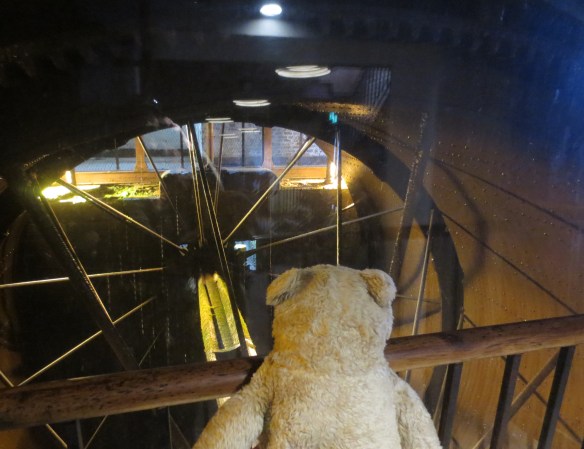 Later steam engines were also introduced to increase production.
 Here I am sat on a water wheel shaft which shows how big it is. We got ‘photo bombed’ by a little dog!
 We didn’t have time to visit the house where the mill owners lived but finished our visit with a refreshing walk through the woods where the Gregg’s children used to play, but I don’t think the children that worked in the mill would have had much time or energy left for playing.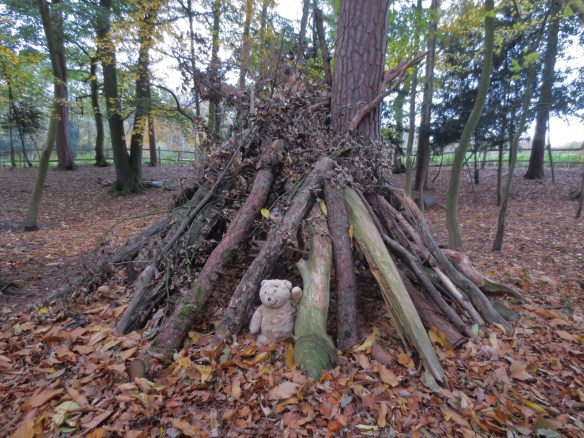
 We had no idea that it was a special day but were quite delighted to find that it was Daffodil Day. There was an exhibition displaying the many different varieties.
 Daffodils were strung up in a garland outside the old packing shed.
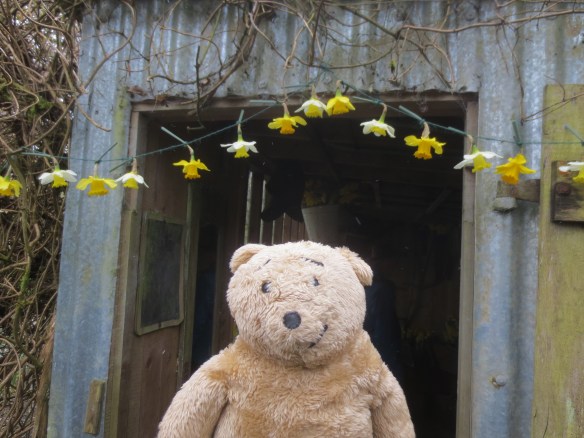 Years ago sheds like this were used to pack up flowers and fruit to be taken to markets to be sold.
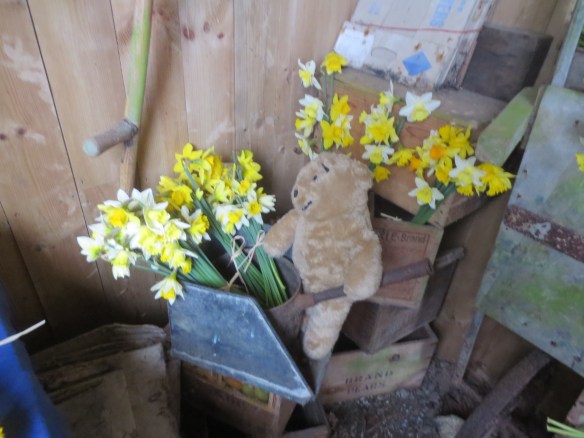 There were lots of old fruit trees in the Old Orchard.
 The trees in the Mother Orchard were younger (planted only ten years ago) and had little pots around the bottoms of them for small bears to sit in. It started snowing while I was having my little rest; hence the white specks on the photograph.
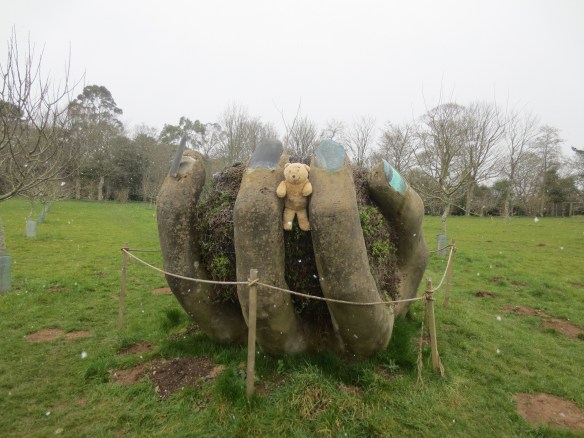
 Amongst the apple trees that was a huge hand as though there might be a giant underneath the ground. I think a manicure was needed as one the nails was broken.
 At the edge of the field a large building housed a cider press. I like cider but as I am only quite small I only have a few sips to taste it now and then.
 I was pleased to find a glasshouse as although snow can be fun it also makes fur wet and cold. Glasshouses are usually warm.
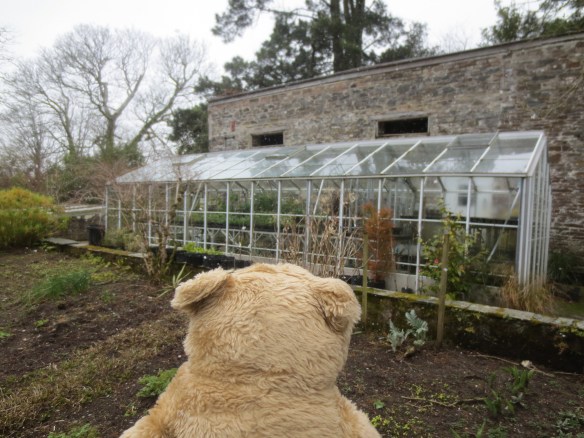 There were lots of seedlings growing in pots. Some of the pots were empty; the gardener told us that a mouse had been nibbling them.
 The snow continued to fall as we walked on around the gardens.
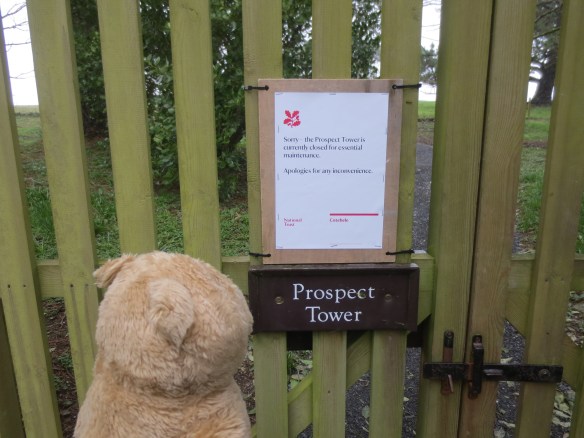
  The Prospect Tower was closed for maintenance. Maybe we will see it next time we visit.
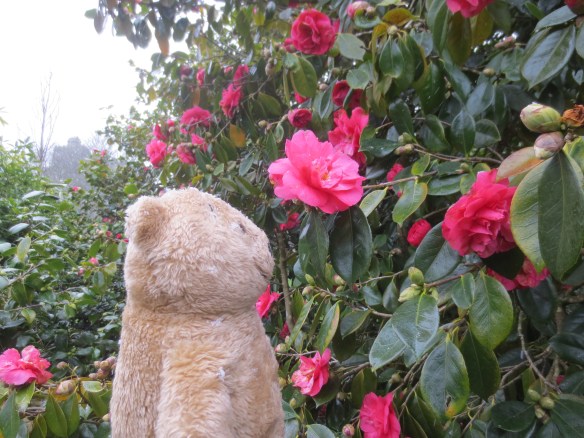
 The beautiful blooms of the camellia didn’t seem to be troubled by the snow that was still falling.
 Here I am with the Cotehele House behind me. It is about 500 years old.
 We went into the house and found arts and crafts for sale. I had a chat with one of the grey knitted bears.
  There was a splendid bear sized chair for sale too.
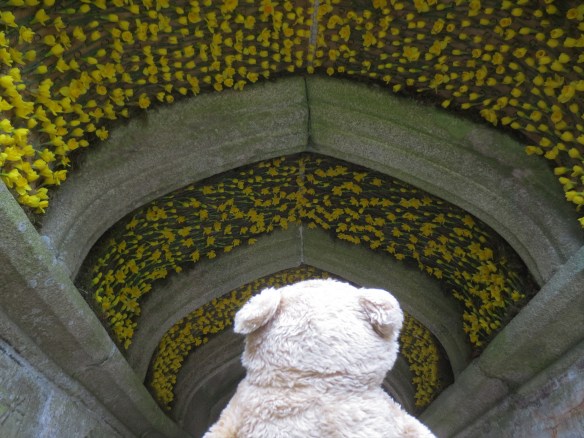
 On our way to the rest of the house I walked through an archway lined with daffodils.
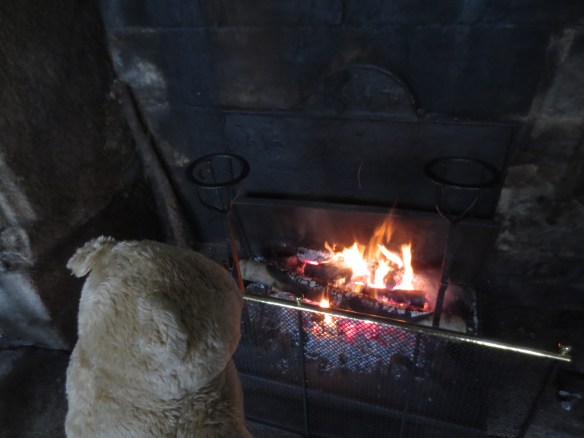
  Once inside again I warmed my fur for a while by the fireplace.
 There was a little chapel just inside the door with a posh fence half way across. Apparently in the old days the rich people that lived in the house would sit one side and the other side was for the poor people who had to stand and came in through a different entrance.
 I sat at the organ but decided not to play it as I thought ‘Teddy Bear’s Picnic’ might not be appropriate.
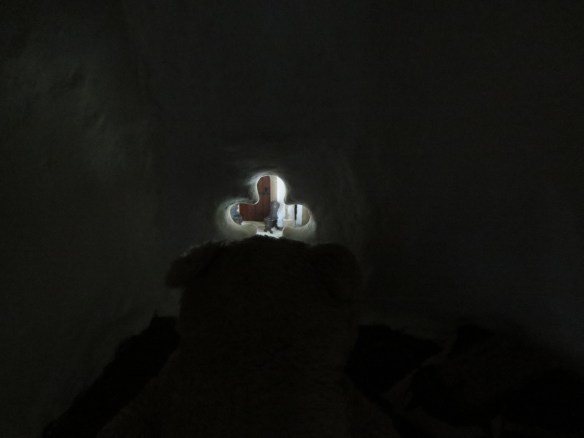
 After going up some stairs I arrived at a little hidey hole that had a tiny window.
  I peered through and could see the room downstairs. It was a spy hole!
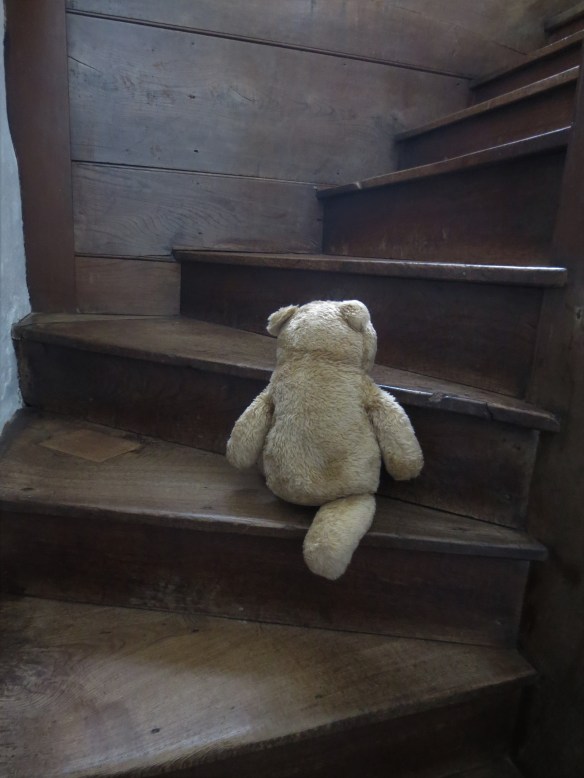
 My legs always get very tired climbing the steep stairs of stately homes.
 Outside it was still snowing so I was glad to be indoors.
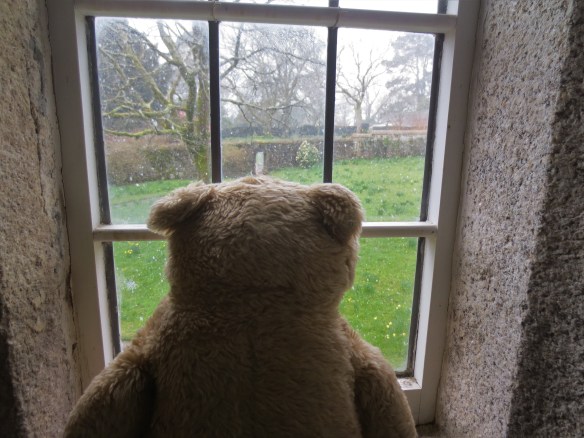 In the kitchen there was another fire keeping visitors and the National Trust volunteer guide warm.
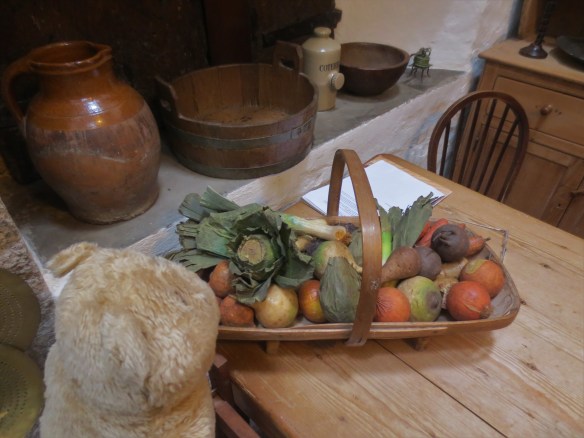
 I thought it was probably time these vegetables were made into a stew.
 The sink was very interesting indeed.
 Unfortunately I fell in. It was just as well that there was no water in the bottom.
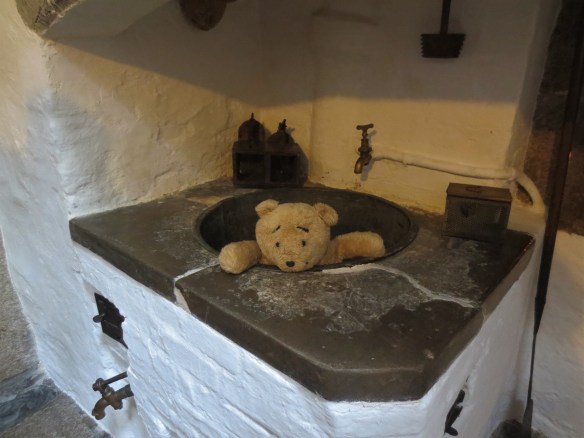 The humans helped me out and pointed out to me that there was a little fireplace underneath which would have been lit to heat the water in the sink.
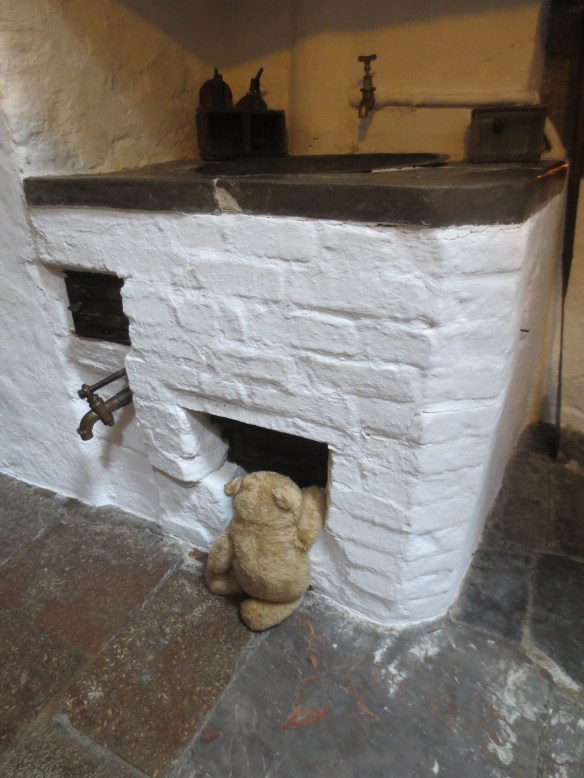 Next to the sink there was an enormous stone oven where many loaves of bread must have been baked.
 Up above on the wall was a big shovel that reminded me of the ‘pizza peel’ that we have at home.
 The kitchen had buckets (made of leather) which would have been jolly useful had there been a fire.
  I had a last look at the house before we set off to walk down the valley to the Quay.
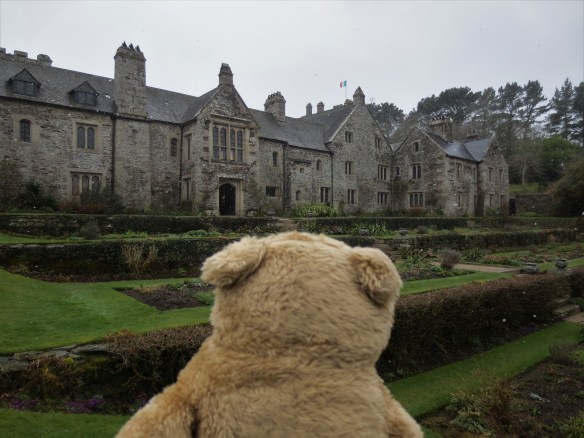 On the way I sat for a while in a little thatched shelter and watched the snow falling.
 A little stream ran down the valley. I think lots of the plants were still asleep for winter but there were a few primroses braving the cold.
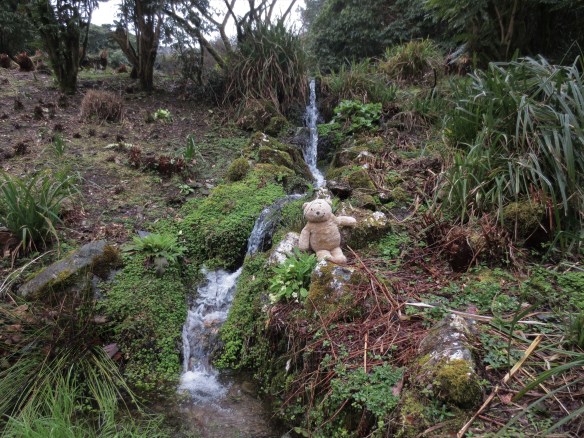 At Cotehele Quay I was hoping to see a very old barge build in 1899 called the Shamrock. However, it has been put in a tent to protect it.
 I persuaded one of the humans to lift me up and I had a quick peek through one of the holes in the tent. The Shamrock did indeed look very old.
  Further along the quay I was pleased to find a seaworthy boat. The Little Charley.
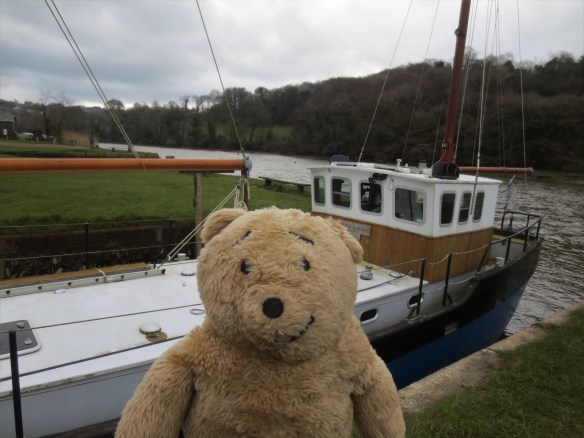 We walked on to see the waterwheel which was being driven round and round by the water dropping on top of it. This is still used to grind wheat into flour.
 I wasn’t in luck for a freshly baked bun though as the baker wasn’t there.
  There was a very interesting little outdoor cupboard near the mill where many years ago people used to keep butter in order to keep it cool.
 The thought of flour, butter and baking made me feel extremely hungry. The Edgecombe Tearoom is an excellent place for hungry bears.
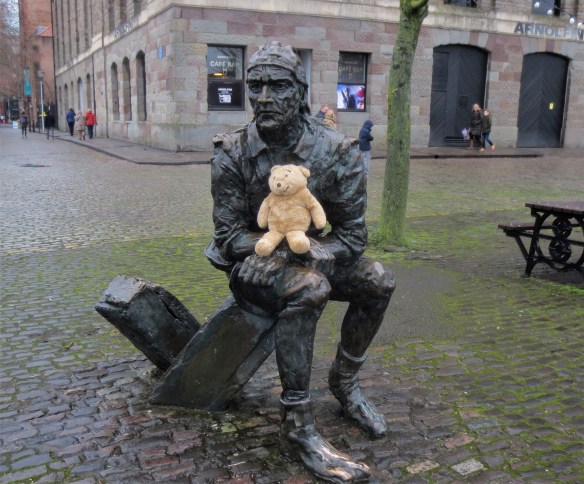
 On the way to The Matthew I bumped into John Cabot.
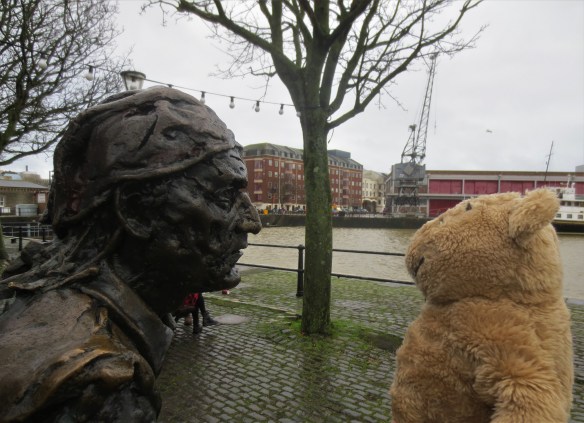 He spends all his time now watching the ships in the harbour.
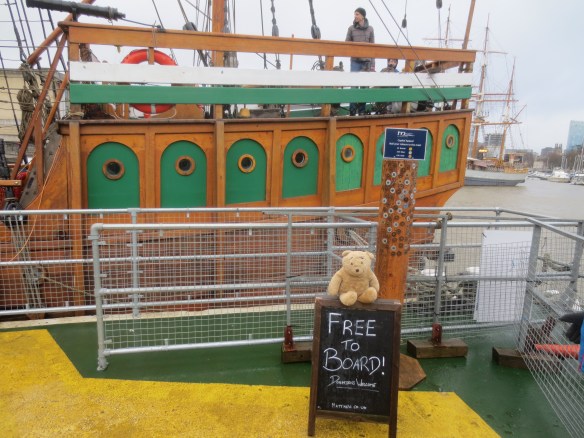
  On reaching The Matthew we found that it was ‘free to board’ which is excellent news for anyone interested in historic ships especially if they don’t have much money.
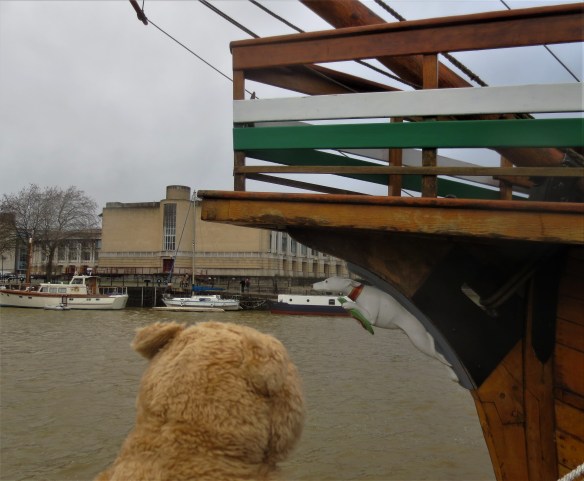
 On the front of the ship there is a white dog that I think might be a greyhound. It looked rather like he might be holding onto a small surfboard.
 Once on board I climbed up the steps to the front of the ship.
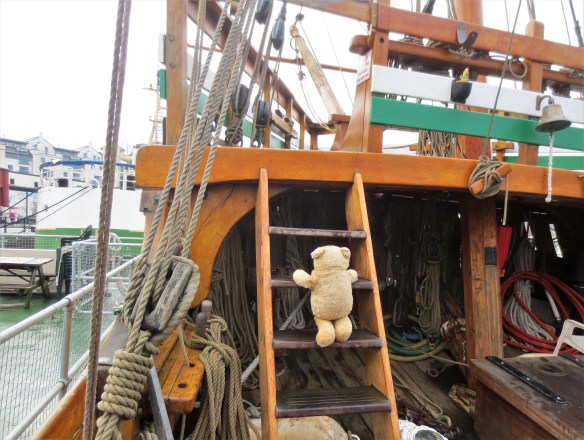 I promptly rang the ship’s bell, which momentarily caused lots of people to look at me.
 I was about to come down the stairs when a volunteer lady who helps look after The Matthew told me I must turn around and come down backwards as I might fall going face first.
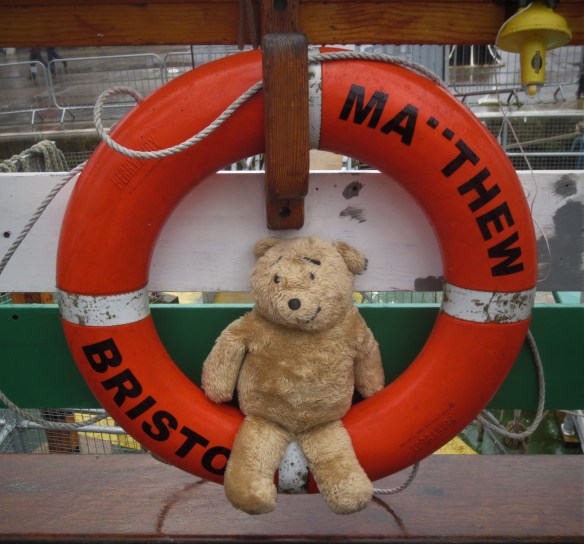
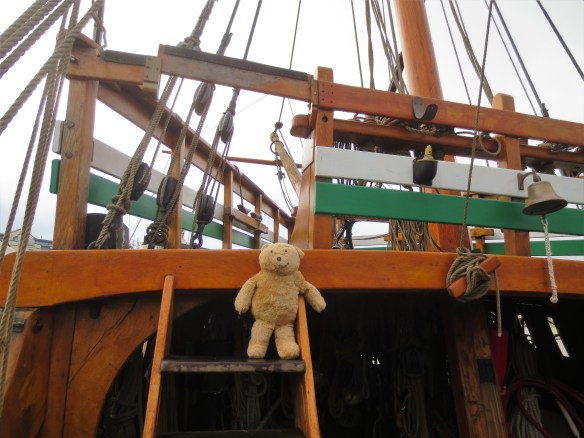 I took her advice and safely reached the bottom. I stopped for a little rest, sitting in the life ring in order not to get my bottom too soggy.
 There is an excellent view of the old steam cranes from The Matthew.
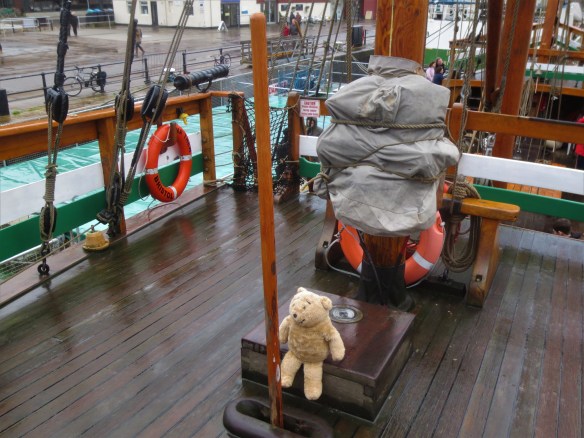
 Here I am inspecting the steering rod. It is incredible to think this little ship has travelled 2271 miles across the ocean.
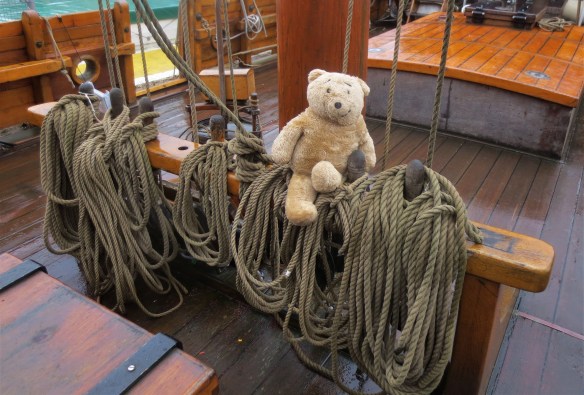
 There are many piles of rope everywhere. Ropes are very important in a sailing ship and are used to raise, lower and control the sails. I think I might just get all tangled up in them if I tried to use them.
 I peered out of one of the little port holes, being careful not to get stuck. I could see some water below so quickly pulled my head back. Water is a big problem for me as I soak it up and cannot swim.
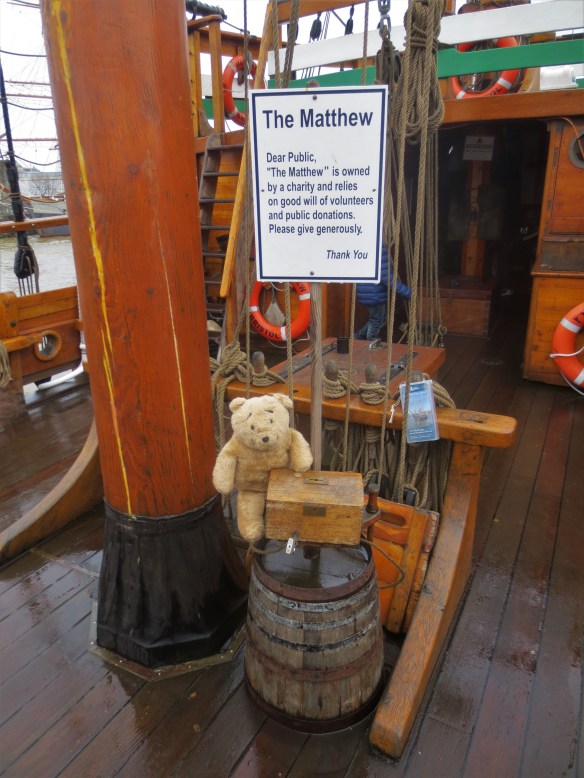
 Before leaving I put a donation in the box. I like The Matthew and the money helps to maintain her.
  I am hoping the humans might take me on a cruise on The Matthew one day.
 The herd of deer certainly aren’t bothered by cold weather; they were enjoying the winter sunshine.
 After exploring the deer park I strolled down through the woods towards the big house.
 There was no chance of getting lost as there was a very big sign post.
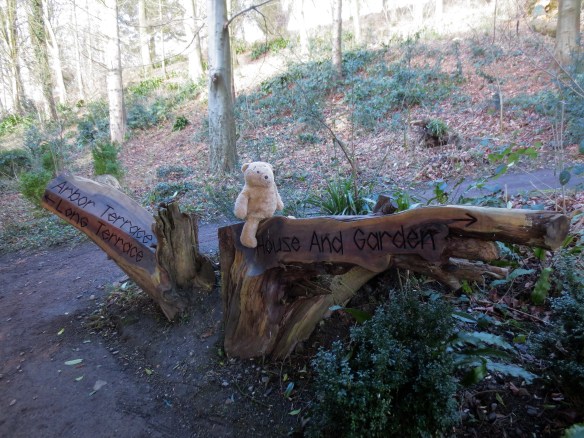 I didn’t see many birds but it might be that birds are afraid of bears.
  After my walk my legs were feeling a tad tired so I stopped for a rest and enjoyed the warmth of the winter sunshine on my fur.
 In the formal gardens behind the big house a group of volunteers were busy working.
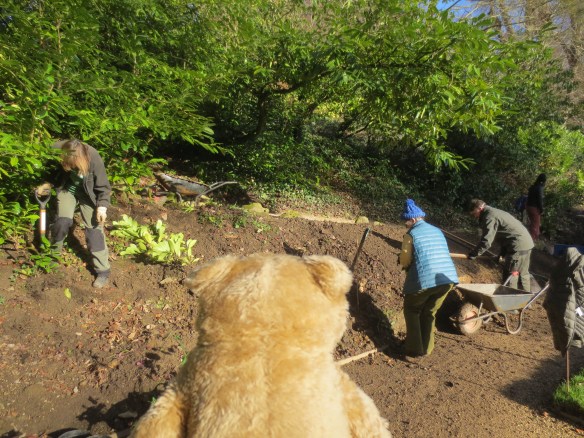 Being a very helpful bear I decided to assist the gardeners for a while.
  It wasn’t long before my wheelbarrow was full up.
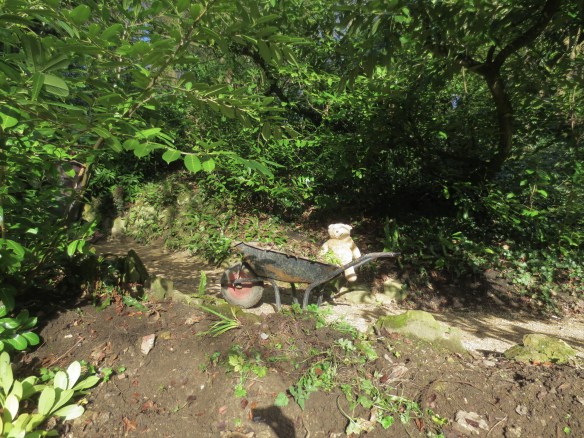 The gardens still have some colour even in January. The dogwood was very colourful.
 I would have liked to get a bit closer to the waterfall but there was a little fence along the lawn to remind people not to walk on it. Walking on grass that is wet can make it all muddy.
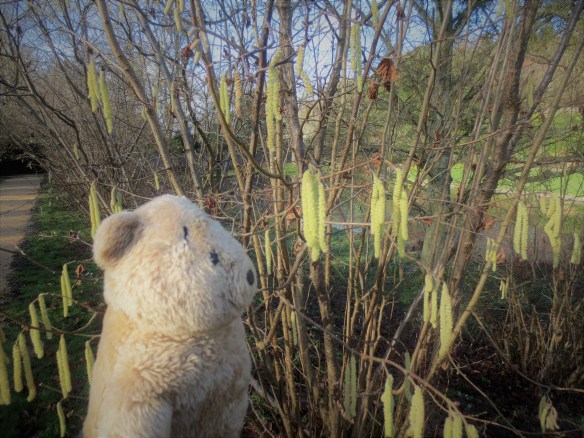
  A hazel bush that must be in a slighty sunnier place that the other hazel bushes had lots of wiggly catkins dangling from it.
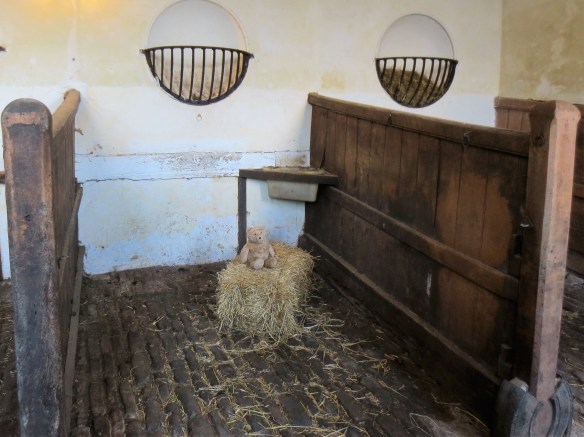
 I went into the stables but the horses weren’t at home. The bale of hay was rather prickly to sit on for very long.
 In the shop I wondered about buying myself a hat. My human often wears a cap; this one was rather large though and not quite me.
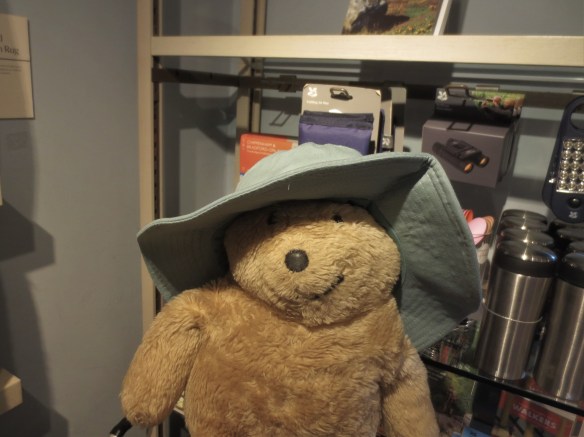
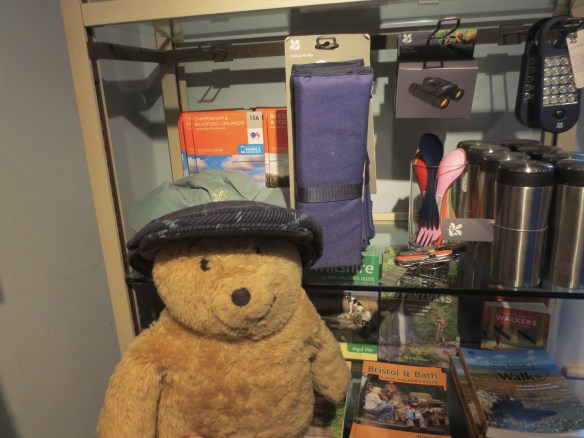 The brimmed hat restricted my vision too much.
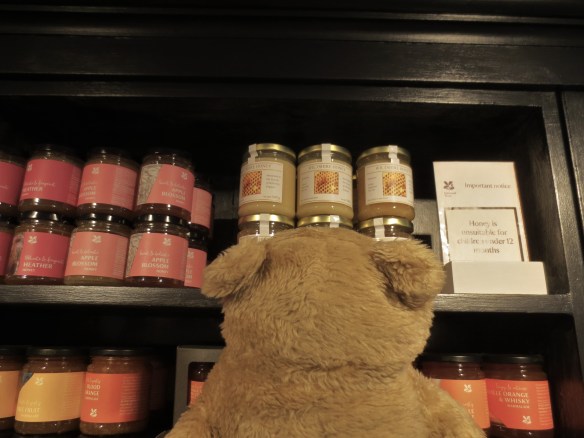
 Locally produced honey is always good.
  I decided to buy the honey; much better for a bear than a hat.
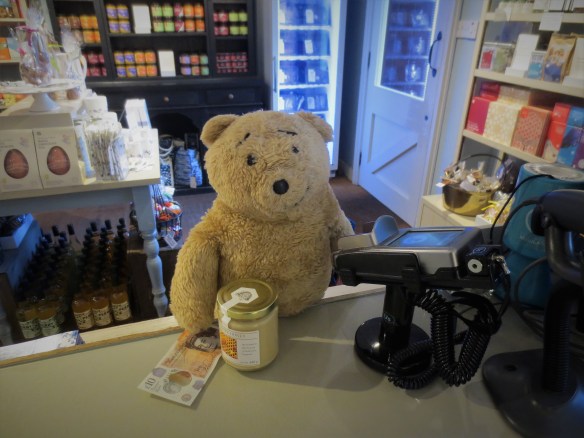 After so much exploring it was time for lunch. The venison pasty was very good for bears. Yum yum yum.
 National Trust properties always seem to have a 2nd hand book shop. At Dyrham they keep the thin books in the sink. I hope no one turns on the tap.
 I found a very useful book to read while the humans browsed all the other books.
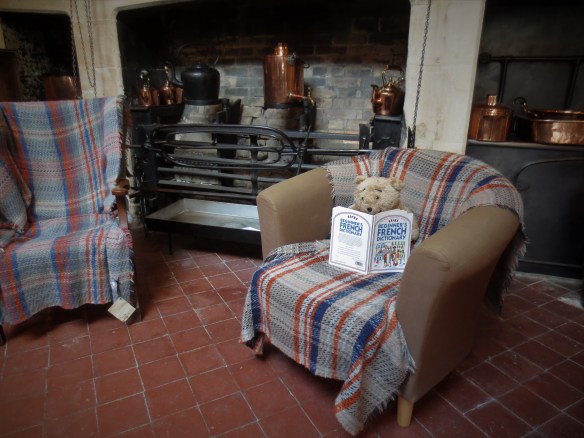 In the cold store there was some food that looked quite appetising until further inspection revealed that it was made of plastic.
 The large bowls were all empty but when the house was lived in long ago they would have been used to keep things cool.
 Before going on our winter tour of the house I put my honey in a locker to keep it safe, and to prevent me from accidently swinging it into an antique vase.
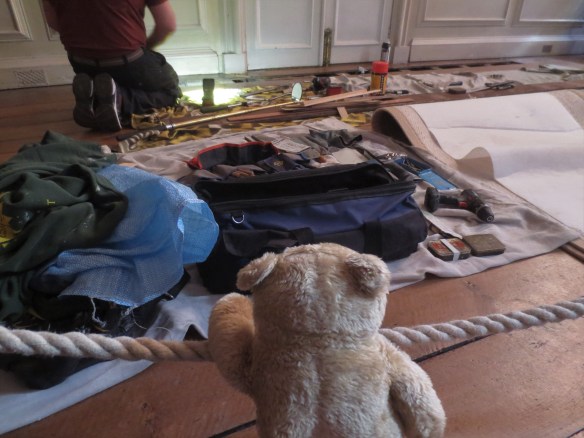
 Inside the house there was work going on. Some beetles had been nibbling away at the floor in The Great Hall, so some boards had been taken up for repairs and restoration.
 Another room was very odd. The walls were covered in 300 year old gilt leather.
  I had a closer look at the leather. Someone must have worked very hard decorating it, but I didn’t like it.
  After emerging from the house I was delighted to find snowdrops. I like snowdrops; they make me feel that spring is coming soon.
 Here is a selfie of me in front of the house.
  When it was time to leave, there was a bit of a challenge for me. Cattle grids (or perhaps deer grids) are not very bear friendly.
 Karen rescued me as the bus that takes visitors from the car park down to the house and back was approaching and needed to cross the grid.
 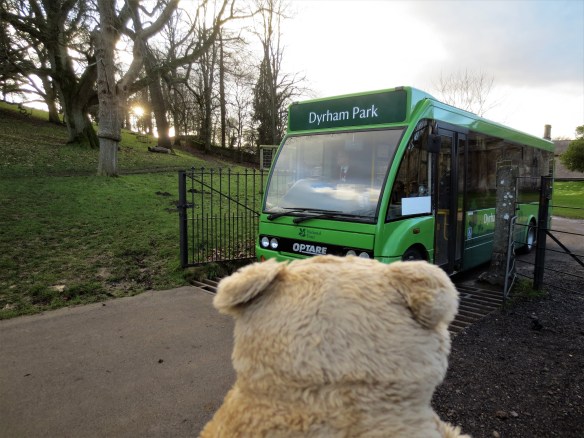 We didn’t get on the bus. My humans like to walk, but my little legs were tired after such a lot of exploring so I had a lift back up to the carpark in the bear carrier.
 Dyrham Park is an interesting place for humans and bears to visit even in winter.
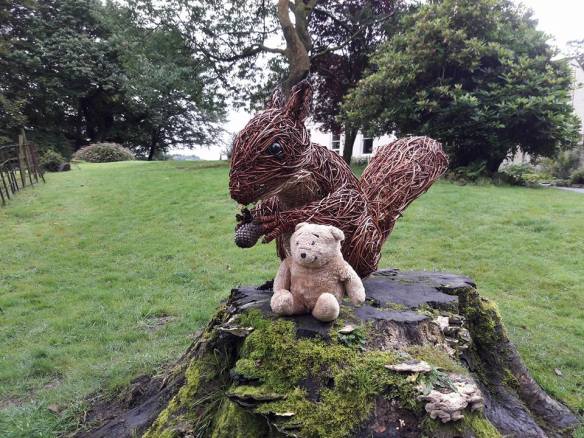
 At the entrance to the gardens I posed for a photo with a willow squirrel, and hoped that I would see some of the real red squirrels that live in the garden.
 There is a splendid view from the garden of the hills surrounding Grassmere.
 Here I am just before going into the house. I could see the lake from here but forgot to get a photograph.
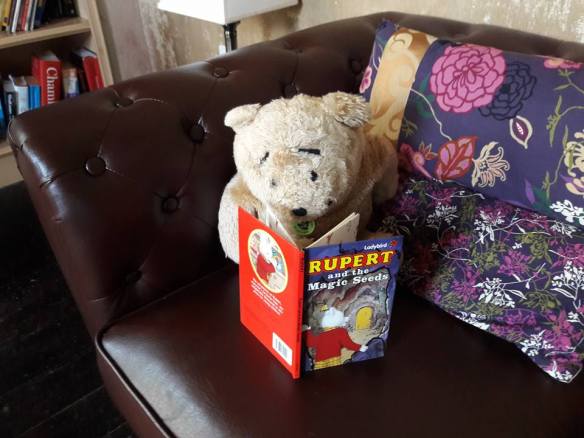
 National Trust properties often have a room containing books for sale. I read Rupert and the Magic Seeds while the humans browsed. I think Rupert wears rather silly trousers.
 The next room was set up as an art room, with tables suitable for full grown humans and small humans and bears to have a go at painting. I did a quick self portrait.
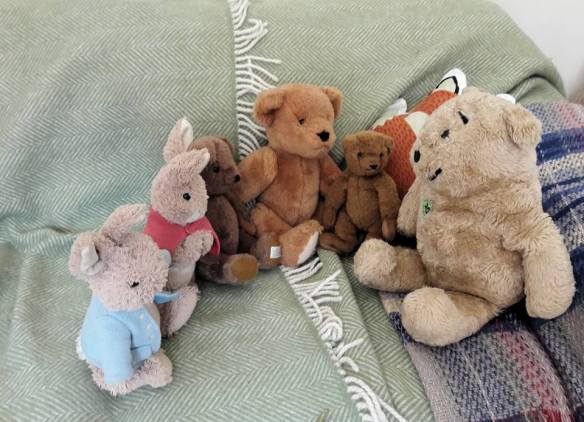
 After going upstairs a guide suggested that I might like the play room. The inhabitants were certainly very pleased to see me.
 I had a little ride on a wooden horse that rocked but didn’t go anywhere.
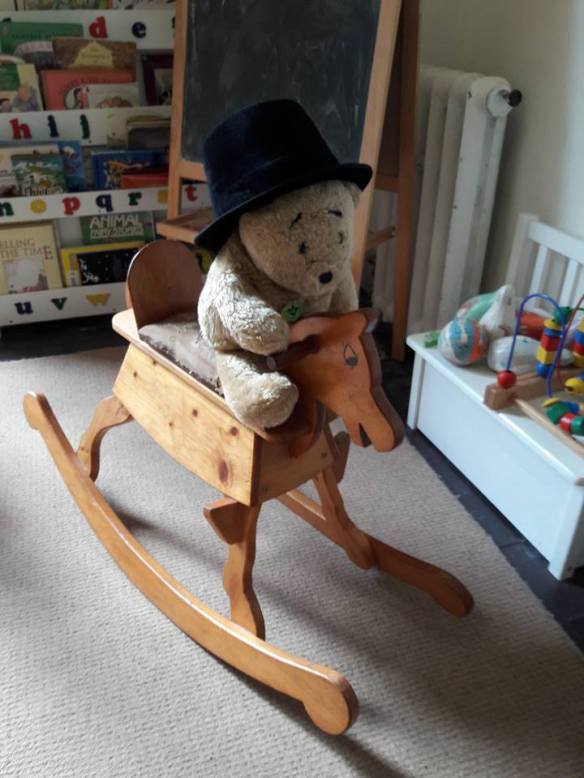 There were lots of hats to try on. I don’t think I would make a very good police bear.
 Two of the resident bears put on a special afternoon tea for me.
  Before saying my farewells I tried out the blackboard.
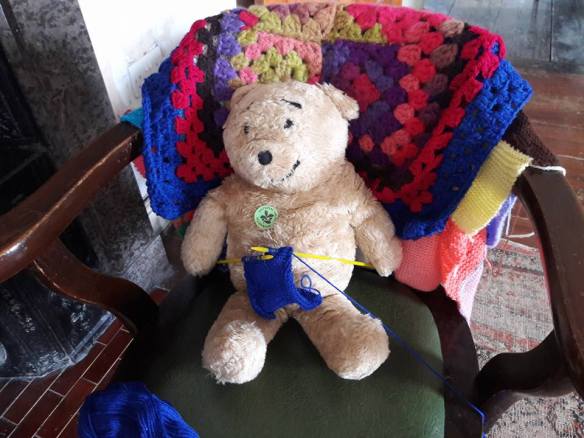
 Allan Bank has a special room for knitting. I did a few more rows of someone else’s knitting and would have continued but the humans said we needed to get some cake before the cafe closed. I like cake.
 There was also a great selection of games in the knitting room that visitors can play. The croquet set was just the right size for me; I struggle somewhat with full size croquet mallets.
 Next to the games table there were lots of knitted animals from the Beatrix Potter stories. They all seemed very busy but Jemima Puddleduck quacked a few times to me.
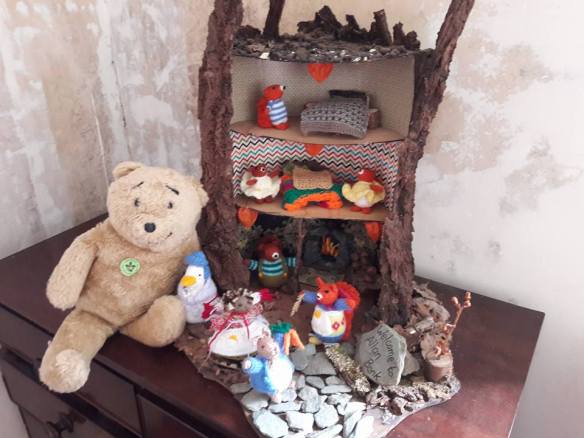 Cuddly squirrels were for sale in the next room. Unfortunately I didn’t get to see a wild red squirrel (though the humans have promised to take me to Brownsea Island oneday where red squirrels also live). I started reading ‘Squirrel Nutkin’ but didn’t finish as didn’t want to miss cake.
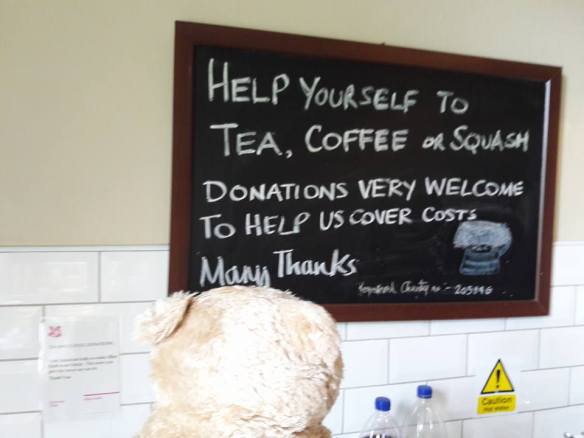
  We made our own cups of tea and put some money in the donation box, then bought some cake at the cafe counter.
 It was a huge piece of very yummy carrot cake.
  On the way out I posed for another photo.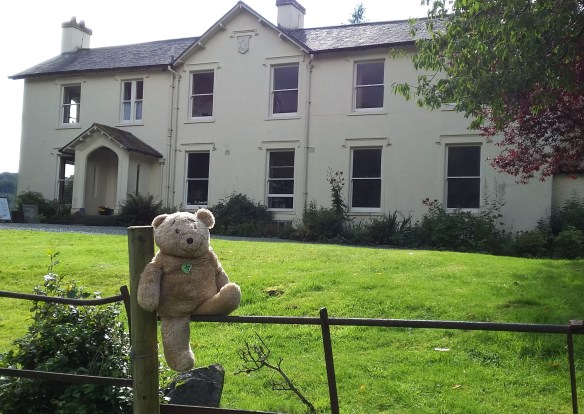
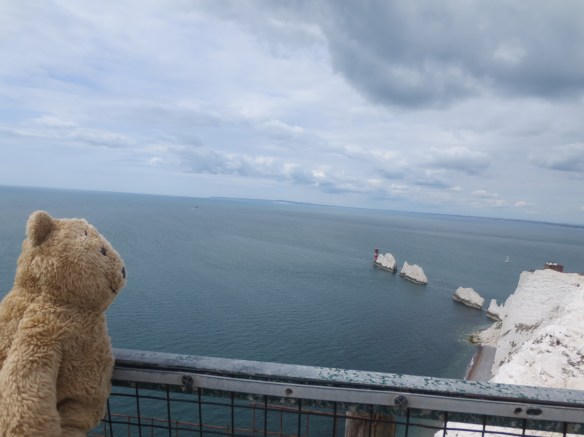 I then noticed a sign stating that we were at a site that had been used for testing rockets.
 Here I am looking at the place where rockets were tested. Their engines were started up but they didn’t actually take off here, they were strapped into special gantries to keep them still. If everything worked the rockets were taken to Australia to be launched into space.
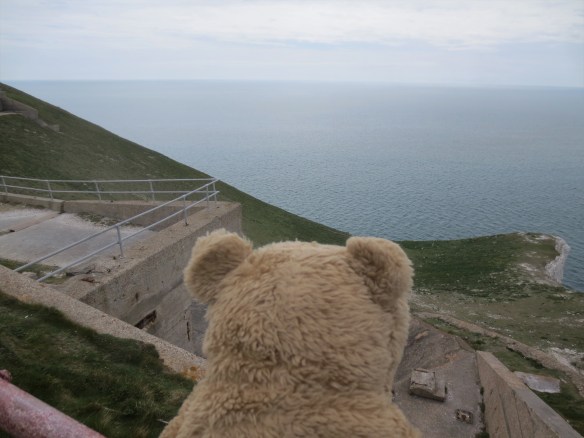 I spotted a couple of rabbits hopping about but they didn’t wave. I think they are quite cautious when it comes to bears.
 The rockets gathered large amounts of information about space. A Black Arrow rocket launched the first British satellite. The satellite is no longer used but it still orbits around the earth twice a day.
 Here I am sat on a life size scale model of the Prospero satellite.
 In another room there was some equipment which was used for gathering information during the tests. I climbed up for a closer look but I didn’t touch!
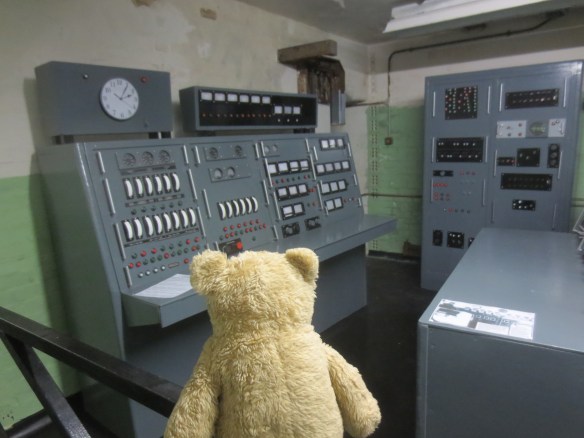
 Here I am in the control room. It isn’t actually the original equipment, but I think it looks quite impressive.
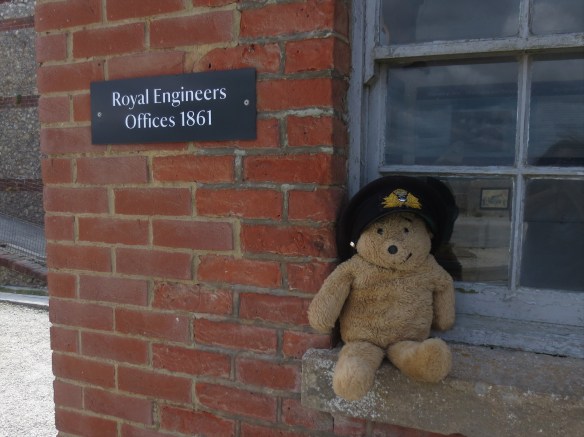
 The Old Battery, which was built in 1861 by the Royal Engineers, and their site office was the first building constructed.
  Before going into The Cartridge Store I had to put on special clothing made of calico to ensure that I didn’t take any gunpowder out of the building.
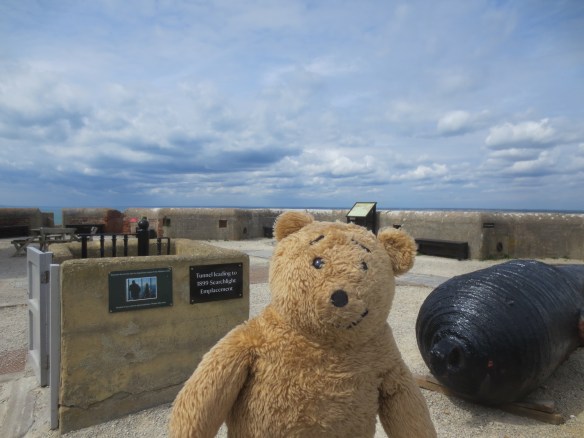
 I was very excited to find an entrance to a tunnel leading to an 1899 searchlight emplacement. Here I am running back to the humans to tell them about it!
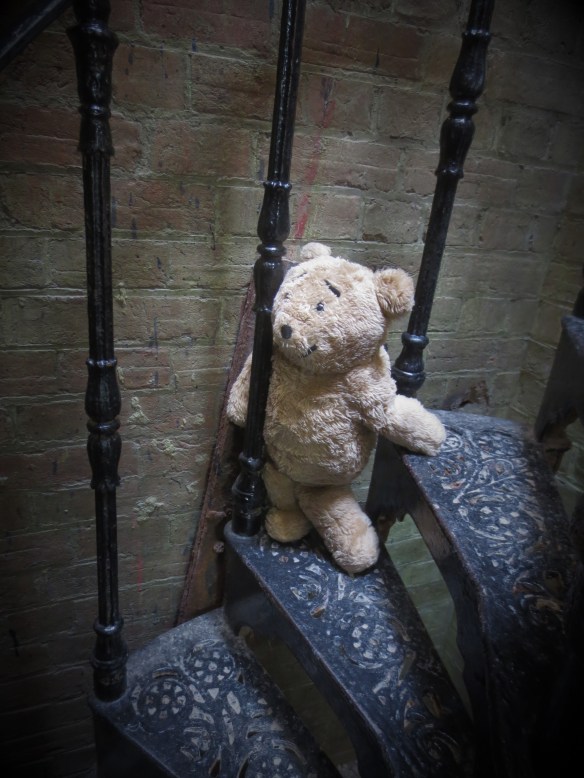
 I climbed down to the tunnel using a spiral staircase fitted by the National Trust; access used to be via a ladder.
 The tunnel was very long and quite a walk for a small bear.
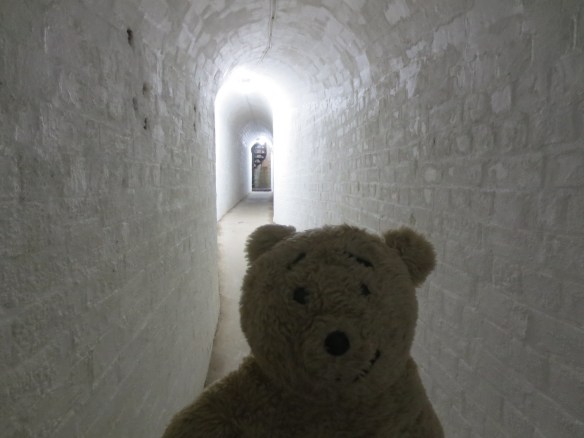 I was quite relieved to see the light at the end of the tunnel.
 There was an excellent view of The Needles from The Searchlight Emplacement. Fortunately I didn’t get my head stuck.
 The tearoom is situated inside The Signal Station. The hot quiche lorraine warmed me up as a cold wind had blown up outside.
  I managed to persuade the humans to buy me some cake too 🙂
 Yum yum yum……. tea soaked fruit cake
 Here I am in front of The Signal Station in the sheltered pathway to the position finding cell.
 There was a special instrument in the Position Finding Cell for gathering information about the whereabouts of ships and the direction in which they were travelling.
 The weather was changing and I was quite worried that my fur could get a soaking so I had one last look at rather splendid Needles before we hurried off down the hill towards the car.
 I stopped briefly to admire the coloured sands of Alum Bay, which is situated next to The Needles.
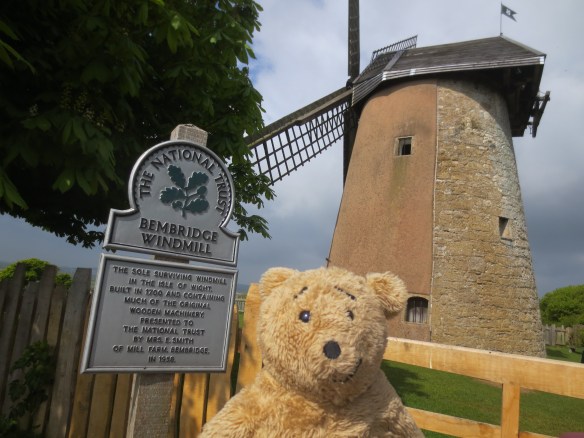 After showing National Trust membership cards to a man in a hut I bought a souvenir guidebook.
 I had a good look at the top of the windmill, where there is a big wheel and a wooden screw called a ‘Worm Screw’. There used to be chains that hung down and the miller would have used the chains to turn the the top of the mill, known as ‘The Cap’ to face the wind.
 I also had a good look at the four wooden frames (before posing for a photo by the door). The frames would have been covered in canvas sailcloth, and a small boy known as a ‘Nipper’ had the job of climbing out onto the frames to attach the cloth. I don’t think I would want to be a nipper.
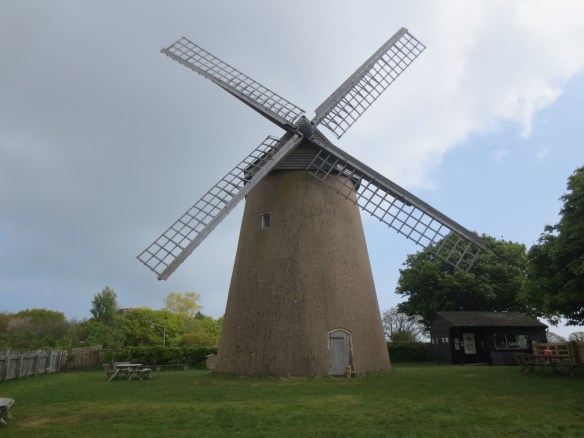 Once inside the windmill I set about climbing up to the top. This took me quite a while.
 At the top there was a trap door. I was a tad worried that it might suddenly open up so I decided not to walk over it. Sacks of grain used to be hoisted up through the trap door.
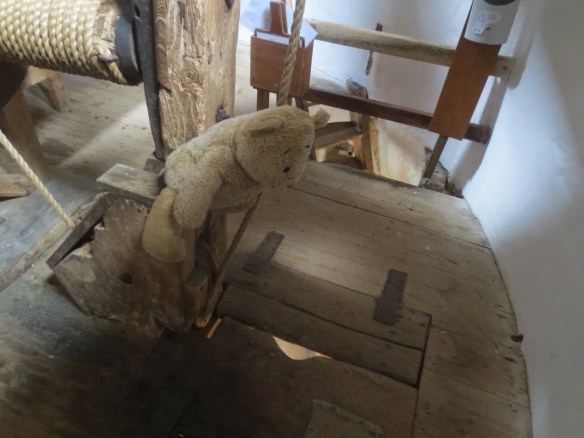 Grain would have been tipped out of the sacks into this huge wooden bin. The grain then traveled downwards through canvas chutes to the hopper above the mill stones on the floor below.
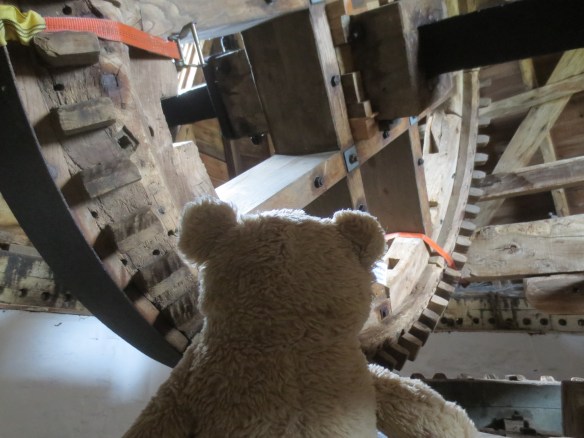
 There was an enormous wooden wheel with an iron band around the outside; known as ‘The Great Brake Wheel’. The miller would have applied the brake by pulling on a rope (which was attached to a lever) which was passed down on the outside of the mill. The Great Brake Wheel was used to slow down or stop ‘The Wallower’ (the horizontal wheel) which drove the upright shaft.
  I carefully went back down the wooden ladder to ‘The Stone Floor’ where the millstones are housed. I got a bit distracted here as there were some windows, so I climbed up to have a closer look at the sail frames.
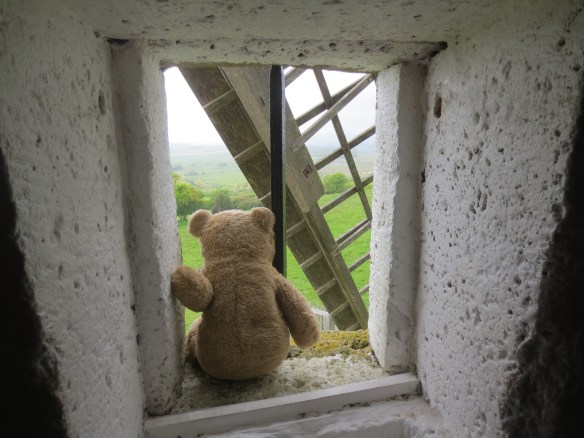 One of my humans took a photo of me from the outside!
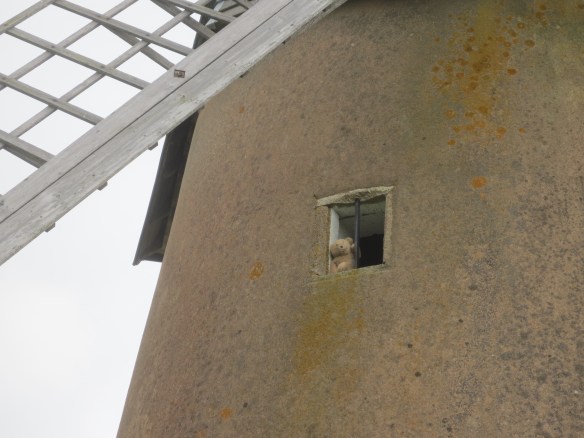 The next floor down is ‘The Machine Floor’, with the huge upright shaft which takes power from ‘The Wallower’ at the top of the mill to the great spur wheel. Here I am sitting on the leather belting drive having a good look at everything.
 Downstairs there are two millstones that make me look like I am even smaller than I am.
 There were also some weights which were impossible for me to lift.
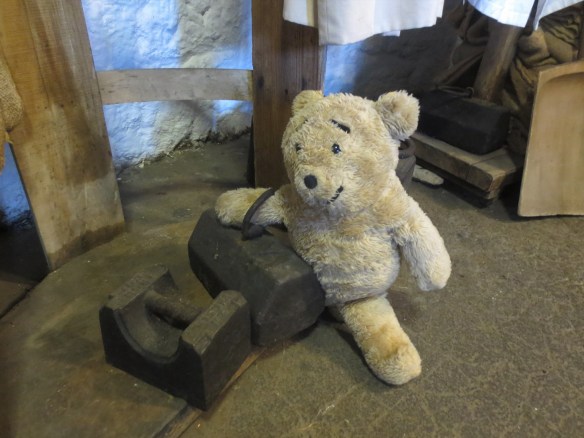 I climbed onto the scales but they didn’t even move. This must mean that I haven’t eaten too many cakes yet.
 On the ground floor I was pleased to find some miller style clothing for people and bears to try on. I rather like the hat but I am not sure about the smock, it was a tad large.
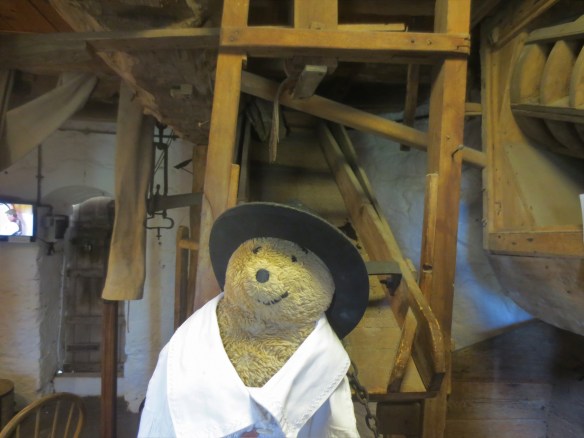 Before leaving the mill I had a go at milling some grain using some small bear sized millstones.
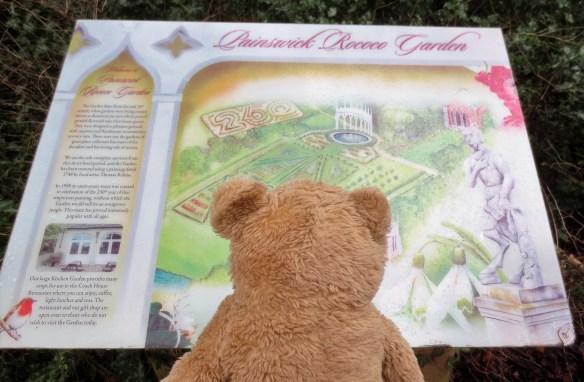
 I was very keen to find the follies. Follies have a tendency to be of good size for bears. The first one I found was quite big though – The Eagle House.
 I was jolly pleased to come across an adventure playground and stopped for while to play on the swing.
 There was a little wicker house near the swing that the Queen sits in when she visits.
 Nearby there was another folly. It took me a while to get up the steep steps to have a look inside.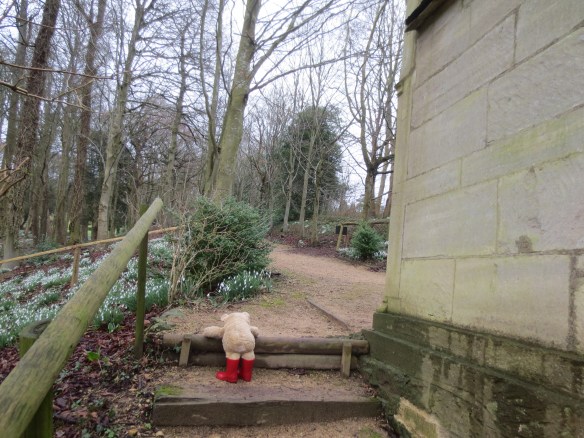
 I am fond of honey bees, so was very pleased to find some hives, and signs warning people to leave the bees alone. The bees were all asleep in the hive for winter.
 Further along the path a magificent fairy tale castle was perched right up on top of an old tree stump. I wondered whether tiny bears might live there, but further inspection revealed that it had been carved out of the tree, so was solid inside.
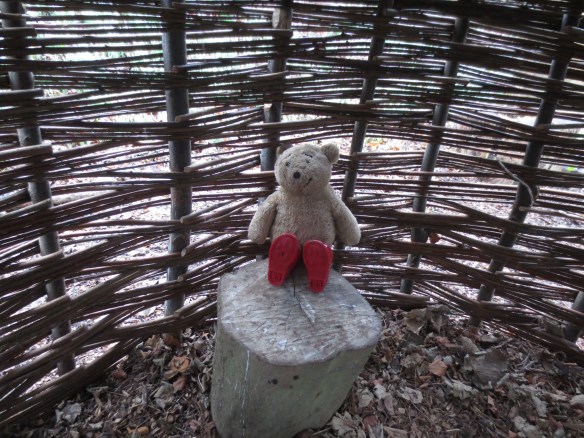
  This little hut was just the right size for me. It is known as ‘The Hermitage’ and is a replica of the one that would have been there over 250 years ago.
 I decided to spend a bit of time being thoughtful in The Hermitage.
 There is a stream running through the garden with lots of ferns and mossy stones. I very much enjoy exploring such places, but the ground was very soggy and slippy making it difficult for me to remain standing (I was designed to sit) so I didn’t spend long there.
 The plunge pool looked a bit cold and deep for bears. One of the nearby trees was wrapped in a blanket to protect it from frost.
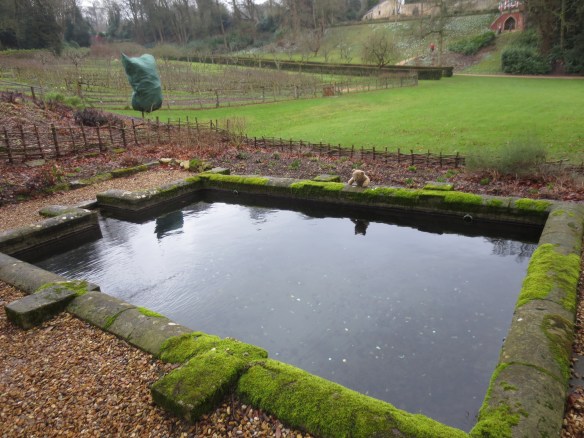 I had a little paddle in the water that was feeding the plunge pool – wellies are jolly useful sometimes!
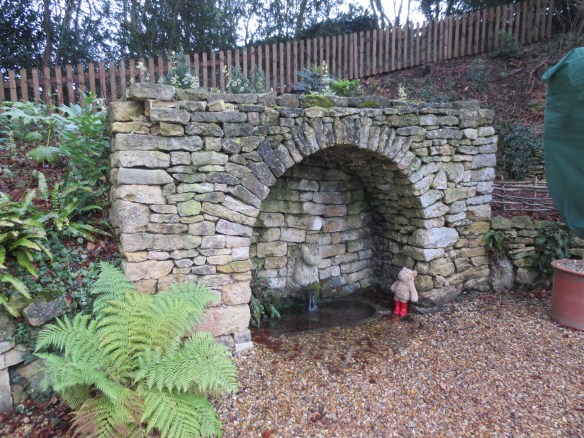 Here I am with another folly. It is rather splendid and makes me look very small.
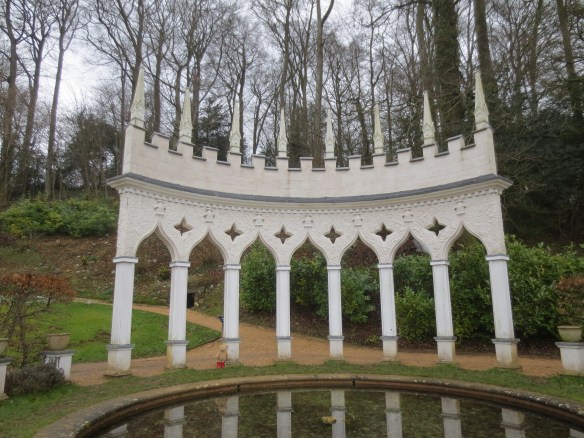 The maze is a more recent addition to the rococo garden. I studied it for a while before entering it as did not wish to get stuck in there!
 I peeped up over the hedge a few times and my humans managed to get a photo of me!
  Wet snow was starting to fall so I was very pleased indeed to come across this little house to shelter in.
 Before we left I had one last look at the beautiful snowdrops.
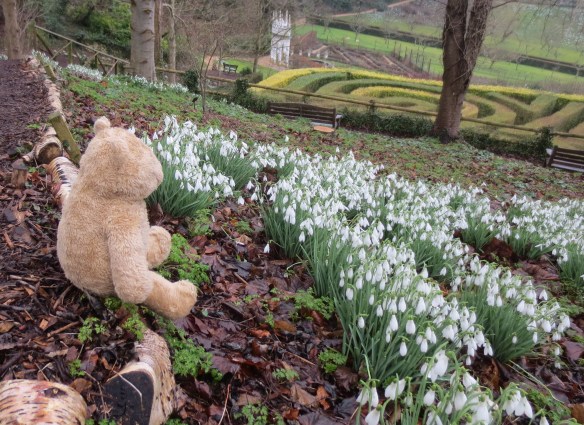 I very much enjoyed visiting Painswick Rococo Garden – a good place for bears and their humans; I think young humans would probably like it too.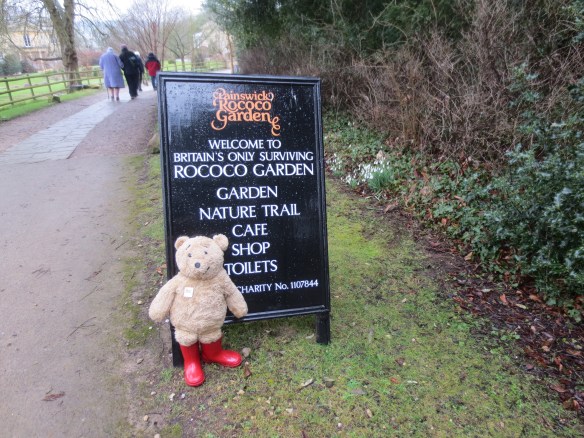
 Horace the Alresford Bear